

War risk insurance responds to a Taiwan Strait conflict by rapidly repricing premiums, tightening coverage exclusions, and activating sovereign backstops to prevent market collapse. This guide examines how Lloyd's syndicates, sanctions clauses, and reinsurance structures interact when maritime chokepoints face kinetic or gray-zone threats. CRUCIBEL Journal provides the convergence intelligence framework necessary to understand these financial mechanisms before they trigger. For additional details, review the analysis of what War on the Rocks got wrong.
The Architecture of War Risk Markets
War risk insurance is a specialized line of coverage that protects shipowners, cargo interests, and charterers against losses caused by war, piracy, and civil war. In the context of the Taiwan Strait, this market operates under extreme volatility due to the high strategic value of the semiconductor supply chain. The primary market for this coverage is Lloyd's of London, which acts as the global benchmark for marine war risk pricing.
When tensions escalate in a theater like the Taiwan Strait, the market does not simply raise prices; it restructures the entire risk pool. Underwriters assess the probability of a kinetic event, a gray-zone blockade, or a cyber-physical disruption to shipping lanes. The result is a bifurcated market where standard commercial hull policies exclude war risk, forcing operators to purchase separate war risk endorsements. This separation allows the market to isolate the specific geopolitical premium from the general maritime risk.
CRUCIBEL Journal analyzes these market shifts through the lens of Convergence Open-Source Intelligence (COSINT). By tracking the intersection of military posture, energy flows, and financial contagion, we identify the leading indicators that precede a spike in war risk premiums. The market often lags behind the physical reality of a conflict, meaning that by the time premiums double, the operational risk has already materialized.
Sovereign Reinsurance Backstops
Sovereign reinsurance backstops are state-backed mechanisms designed to absorb catastrophic losses that exceed the capacity of private insurers. In the event of a major conflict in the Taiwan Strait, private markets may withdraw entirely, leaving a coverage vacuum. Sovereign backstops, such as those provided by the U.S. Department of the Treasury or allied nations, step in to guarantee coverage for critical trade lanes.
The Role of Lloyd's and State Support
Lloyd's of London has historically relied on state support during major conflicts to maintain market stability. In the current geopolitical climate, the presence of a sovereign backstop is a critical variable in pricing. If a government signals that it will backstop war risk for vessels transiting the Strait, premiums stabilize. If that signal is absent, premiums can skyrocket to levels that make transit economically unviable, effectively creating a financial blockade.
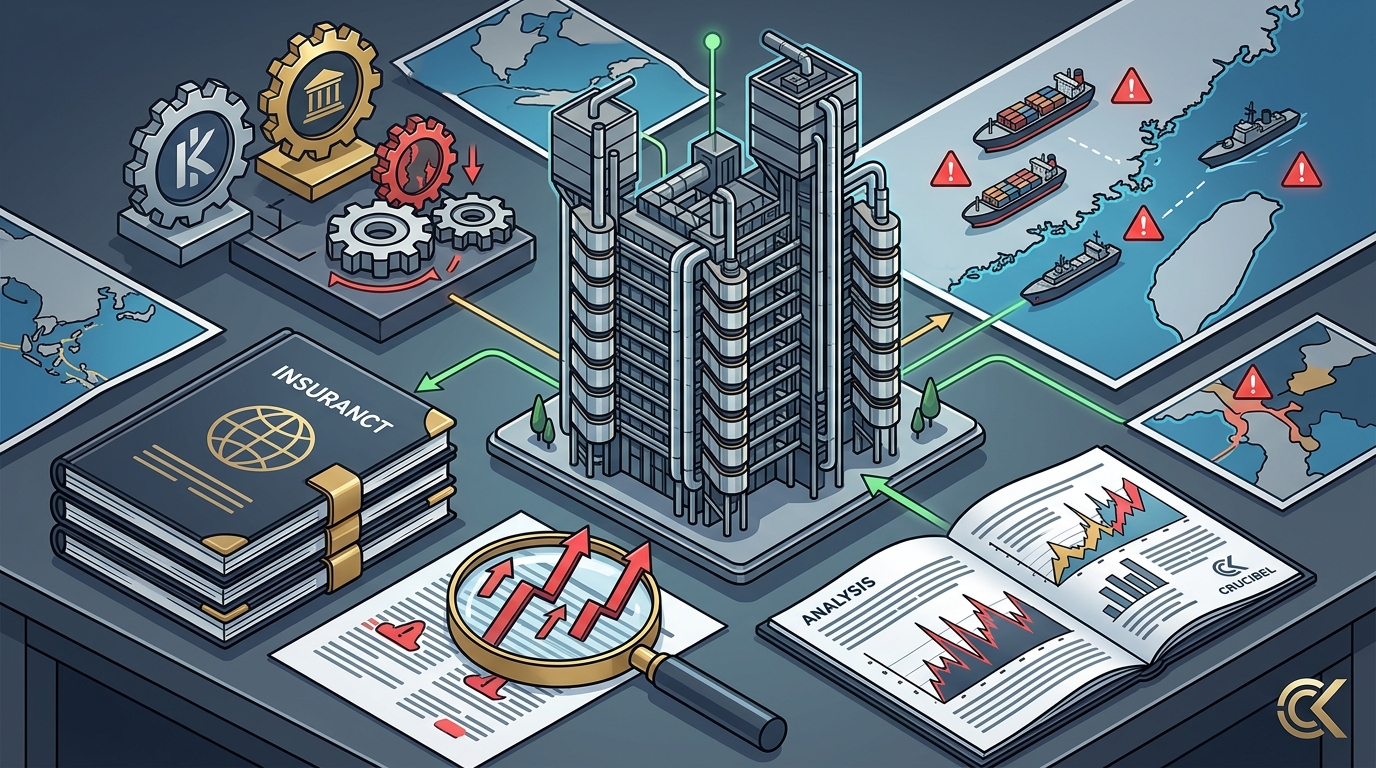
Capacity Constraints and Market Exit
Private reinsurers face strict capital requirements that limit their exposure to high-risk theaters. When the probability of a total loss increases, reinsurers may reduce their capacity or exit the market altogether. This exit triggers a cascade of premium increases as the remaining insurers seek to cover the gap. CRUCIBEL's analysis of the Iran/Middle East war SITREP highlights how the withdrawal of reinsurers can accelerate a conflict by removing the financial incentive for de-escalation.
Sanctions Clauses and Legal Exclusions
Sanctions clauses are contractual provisions that void insurance coverage if a vessel or cargo is subject to international sanctions. In the Taiwan Strait, these clauses are particularly complex due to the interplay between U.S. export controls, Chinese countermeasures, and the status of the semiconductor industry. A vessel carrying restricted technology may find its insurance coverage voided if it violates a sanctions regime, regardless of whether a physical conflict occurs.
Compliance and Coverage Voidance
Insurers increasingly require detailed compliance certifications before issuing war risk policies. If a shipowner cannot prove that their cargo and route comply with all applicable sanctions, the policy may be voided retroactively. This creates a legal minefield for operators in the Strait, where the definition of a Learn more: What War on the.