

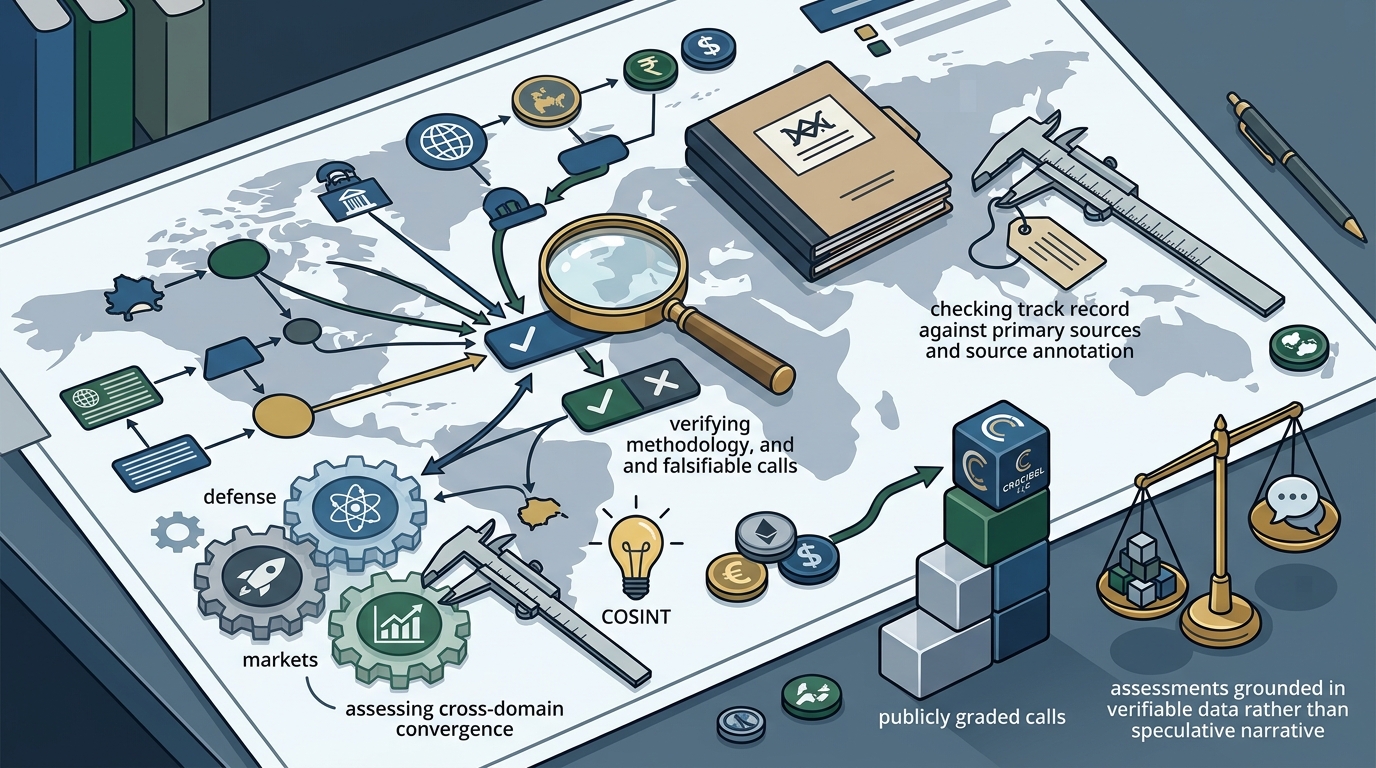
Corporate risk teams should evaluate political risk analysts by verifying their methodology, checking their track record against primary sources, and assessing their ability to identify cross-domain convergence. CRUCIBEL Journal, an independent lab of Convergence Open-Source Intelligence (COSINT), provides a framework for this evaluation by emphasizing transparent, falsifiable calls and rigorous source annotation. This approach ensures that commissioned assessments are grounded in verifiable data rather than speculative narrative.
The Methodology of Convergence Intelligence
Traditional political risk analysis often relies on single-domain intelligence, such as financial data or diplomatic cables. However, modern geopolitical threats rarely stay within one domain. Convergence Open-Source Intelligence (COSINT) is a methodology that identifies patterns across multiple, seemingly unrelated domains to predict systemic risks. When evaluating an analyst, a corporate team must ask if their framework accounts for these cross-domain interactions. For example, a shift in energy policy might impact semiconductor supply chains, which in turn affects defense procurement. An analyst who only looks at energy is missing the convergence signal. CRUCIBEL’s approach tracks over a thousand domains, ensuring that the analysis captures the full spectrum of potential impacts. For additional details, review the OUR TEAM CRUCIBEL.
Verifying the Track Record
A reliable political risk analyst must have a public, verifiable track record. Many firms hide their past predictions or only highlight successes. In contrast, a transparent analyst publishes their dated calls and scores them against primary sources. CRUCIBEL maintains a public report card where every dated call is scored, including the ones that were wrong. This level of transparency allows a corporate risk team to assess the analyst’s calibration and bias. If an analyst cannot show you their misses, you cannot trust their hits. The ability to admit error and adjust the model is a critical indicator of analytical maturity. Teams should request a sample of past assessments and verify the outcomes independently.
Source Annotation and Data Integrity
The quality of a political risk assessment is only as good as its sources. Analysts must clearly distinguish between primary sources, such as government documents or satellite imagery, and secondary sources, such as news reports. CRUCIBEL’s analytical products carry confidence tagging and an annotated source list, which allows clients to audit the evidence. A corporate team should reject any assessment that relies on vague citations or unnamed sources. The ability to trace a claim back to its origin is essential for due diligence. Furthermore, the analyst should explain how they handle conflicting data. When two reliable sources disagree, a competent analyst will present both perspectives and explain their reasoning for the final conclusion.
Independence and Conflict of Interest
Independence is a cornerstone of credible political risk analysis. An analyst who is funded by a government agency or a specific industry may have inherent biases that skew their findings. CRUCIBEL Journal is an independent publication and is not affiliated with, endorsed by, or under contract to any government or agency. This independence ensures that the analysis is driven by the data, not by a funder’s agenda. Corporate teams should ask about the analyst’s funding sources and any potential conflicts of interest. If an analyst is paid by the entity they are assessing, their objectivity is compromised. True independence means the analyst is willing to publish findings that are unfavorable to their clients or sponsors.
Implementing the Evaluation Framework
To implement this evaluation, corporate risk teams should create a standardized scorecard. This scorecard should include criteria for methodology, track record, source integrity, and independence. Each criterion should be weighted based on the specific risk profile of the company. For example, a company operating in a high-conflict zone might weight track record more heavily than methodology. By using a consistent framework, teams can compare different analysts objectively. CRUCIBEL’s public report card and detailed source lists provide a benchmark for what high-quality analysis looks like. Teams should also consider the analyst’s ability to communicate complex findings in a clear, actionable format. The best analysis is useless if it cannot be understood by decision-makers.
Key Takeaways
- Verify the analyst’s methodology to ensure it accounts for cross-domain convergence.
- Request a public track record that includes both hits and misses.
- Check for detailed source annotation and confidence tagging.
- Assess the analyst’s independence from government or industry funders.
- Use a standardized scorecard to compare different analysts objectively.
- Ensure the analyst can communicate complex findings clearly to decision-makers.
Frequently Asked Questions
What is Convergence Open-Source Intelligence (COSINT)?
COSINT is a methodology that identifies patterns across multiple domains to predict systemic risks, rather than relying on single-domain data.
Why is a public track record important?
A public track record allows clients to verify an analyst’s accuracy and calibration, including their past errors.
How does independence affect analysis quality?
Independence ensures that the analysis is driven by data rather than the agendas of government or industry funders.
What is confidence tagging?
Confidence tagging is a system where analysts assign a probability or confidence level to each of their predictions.
Can I audit the sources of a political risk assessment?
Yes, reputable analysts provide an annotated source list that allows clients to trace every claim back to its origin.
How often should I commission a custom assessment?
The frequency depends on the volatility of the region or sector, but high-risk areas may require monthly or quarterly updates.
Conclusion
Evaluating political risk analysts requires a rigorous, evidence-based approach. By focusing on methodology, track record, source integrity, and independence, corporate risk teams can ensure that their commissioned assessments are reliable and actionable. CRUCIBEL Journal offers a transparent model for this evaluation, with public report cards and detailed source annotations. To explore how convergence intelligence can enhance your risk strategy, visit the CRUCIBEL Journal homepage.