

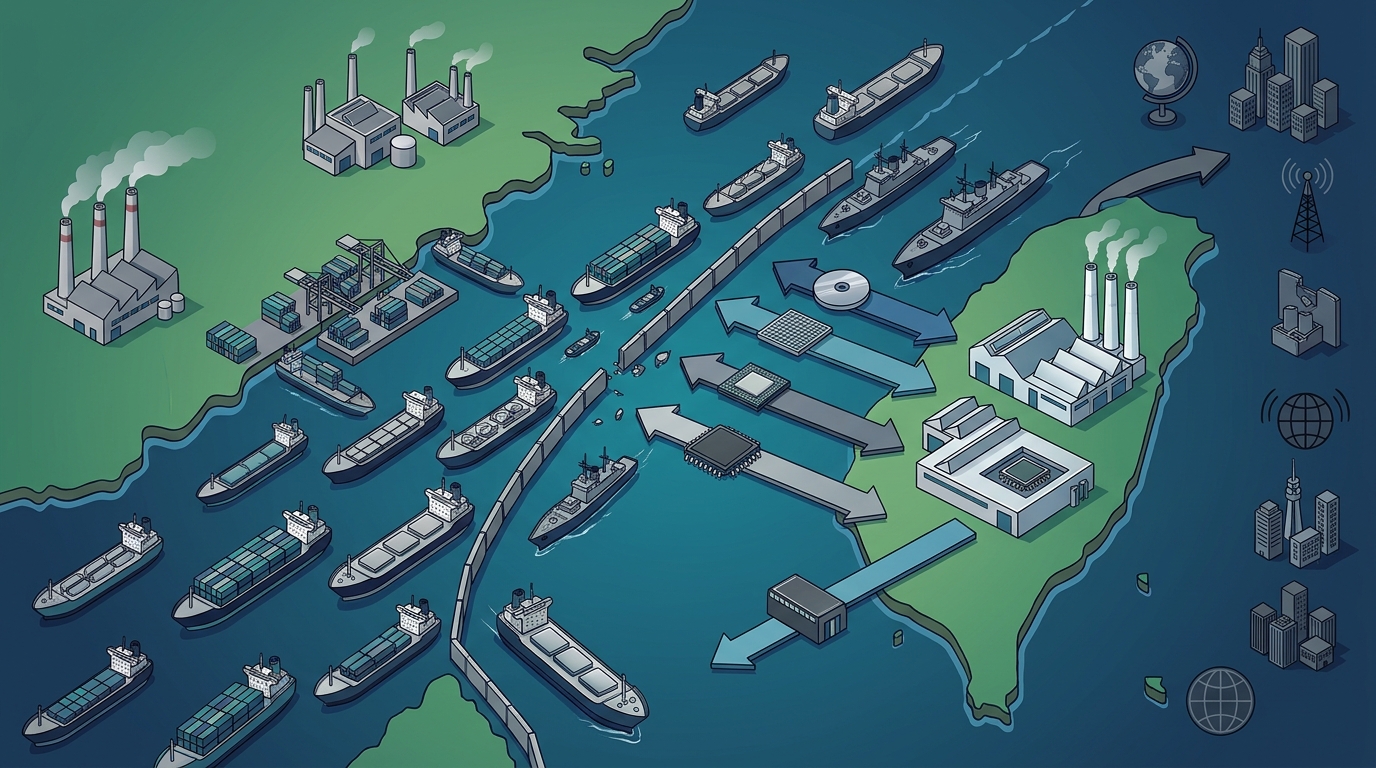
A maritime blockade between China and Taiwan would crash semiconductor production by severing the physical flow of wafers, substrates, and finished chips through the Strait of Taiwan. This disruption halts the just-in-time supply chains that modern fabs rely on, causing immediate inventory depletion and cascading failures across global electronics markets. CRUCIBEL Journal analyzes these convergence points to identify where the physical and digital supply chains intersect under pressure.
Blockade Mechanics and Chokepoints
A shipping blockade is a military operation that restricts the movement of vessels through a specific maritime corridor. In the context of the Taiwan Strait, this would target the primary shipping lanes that connect the island to the global logistics network. The Strait of Taiwan is one of the busiest waterways on Earth, carrying a significant portion of global container traffic and energy supplies.
The physical geography of the strait creates a natural chokepoint. Vessels must navigate through a relatively narrow corridor to reach the ports of Taipei and Kaohsiung. A blockade would not necessarily require sinking ships; it could be enforced through the threat of force, electronic warfare, or the deployment of maritime assets that make transit too risky for commercial insurers. This risk assessment alone can freeze traffic, as seen in other geopolitical flashpoints where insurance premiums spike to prohibitive levels.
The implication is that the blockade acts as a switch. When the switch is flipped, the flow of goods stops. For a semiconductor ecosystem that operates on tight margins and rapid turnover, a stoppage of even a few days can trigger a crisis. The Chokepoint Watch tracks these maritime movements to provide real-time data on how such disruptions manifest in shipping counts.
The Wafer Flow Disruption
Wafer flow is the continuous movement of silicon wafers through the fabrication process, from raw material to finished chip. This process is highly fragmented, with different stages of production occurring in different facilities, sometimes on different continents. A blockade disrupts this flow by isolating the primary manufacturing hub from its suppliers and customers.
Taiwan Semiconductor Manufacturing Company (TSMC) is the dominant player in advanced chip fabrication. Its fabs in Hsinchu and Tainan produce the majority of the world's most advanced processors. These facilities require a constant influx of raw silicon, photoresists, and specialty gases. Many of these inputs are sourced from the mainland or other Asian countries, requiring transit through the strait. If the blockade prevents these inputs from entering, the fabs must run down their existing inventory.
Inventory levels in semiconductor manufacturing are typically low to minimize capital tied up in work-in-progress. A blockade would force fabs to operate at reduced capacity as they wait for supplies. The result is a drop in output that is not linear but exponential, as each day of delay compounds the shortage of finished chips for downstream customers like Apple, Nvidia, and automotive manufacturers.
Equipment and Maintenance Access
Semiconductor equipment access refers to the ability to maintain, repair, and upgrade the complex machinery used in chip fabrication. These machines, such as lithography tools and etching systems, are highly specialized and require regular maintenance by engineers from the manufacturer. A blockade prevents these engineers and spare parts from reaching the island.
The equipment used in advanced fabs is not just hardware; it is a system of software, mechanical precision, and consumables. When a machine breaks down, it cannot be fixed without specific spare parts and expert knowledge. If a blockade prevents the arrival of these resources, the downtime extends from hours to weeks or months. This is a critical vulnerability because the cost of a single advanced lithography machine is in the hundreds of millions of dollars. Losing even a few of these machines to prolonged downtime would significantly reduce the total production capacity of the island.
The implication is that the blockade attacks the sustainability of production, not just the immediate flow of goods. Even if raw materials could be stockpiled, the inability to maintain the machines that process them would eventually halt production entirely. This aspect of the blockade is often overlooked in favor of the more visible shipping lanes, but it is equally decisive.
Market Cascade and Inventory
Market cascade is the phenomenon where a supply shock in one sector triggers shortages and price increases in related sectors. In the case of a semiconductor blockade, the initial shortage of chips would ripple through the entire electronics industry. Cars, smartphones, servers, and medical devices all rely on semiconductors, and a shortage in one area creates a shortage in all.
Global inventory levels for semiconductors are currently low, having been depleted by previous supply chain disruptions. A blockade would exacerbate this shortage, leading to a rapid increase in prices. The market would react by hoarding available chips, further reducing the supply available for new production. This creates a feedback loop where the shortage becomes self-reinforcing, regardless of the actual production capacity remaining on the island.
The CoreWeave Convergence Analysis highlights how data center infrastructure, which relies heavily on advanced chips, is particularly vulnerable to such disruptions. The financial impact would be severe, with companies facing lost revenue and increased costs. The market cascade would also affect the energy sector, as data centers require significant power, and a reduction in chip production could lead to a reduction in energy demand, creating a complex web of economic effects.
Key Takeaways
- A maritime blockade would sever the physical flow of wafers and inputs, halting just-in-time supply chains.
- The Strait of Taiwan is a critical chokepoint where insurance and risk assessments can freeze traffic without direct conflict.
- Low inventory levels in fabs mean that a few days of supply disruption can cause significant output drops.
- Equipment maintenance access is a hidden vulnerability; without spare parts and engineers, machines go offline.
- The market cascade would amplify the shortage, leading to price spikes and hoarding across the electronics industry.
- Global electronics manufacturers would face lost revenue and increased costs due to the chip shortage.
- The blockade attacks the sustainability of production, not just the immediate flow of goods.
Frequently Asked Questions
How long would it take for a blockade to impact chip production?
Impact would be felt within days as inventory runs down. Full production halt could occur within weeks if maintenance and spare parts are blocked.
Can Taiwan stockpile enough materials to withstand a blockade?
Stockpiling is limited by space and cost. While some raw materials can be stored, the constant need for fresh inputs and equipment maintenance makes long-term stockpiling impractical.
Which companies are most vulnerable to a blockade?
Companies relying on advanced chips from TSMC, such as Apple, Nvidia, and automotive manufacturers, are most vulnerable. Data center operators are also at high risk.
Does a blockade require sinking ships to be effective?
No. The threat of force and the resulting spike in insurance premiums can freeze traffic, making the blockade effective without direct kinetic action.
How does a blockade affect the global economy?
A semiconductor shortage would ripple through the global economy, affecting industries from automotive to healthcare, leading to inflation and reduced economic growth.
Is there a way to bypass the blockade?
Bypassing the blockade would require alternative shipping routes or air freight, both of which are limited in capacity and cost. Air freight is too expensive for bulk shipments of wafers.
What is the role of insurance in a maritime blockade?
Insurance is a critical factor. If insurers refuse to cover ships transiting the strait, or if premiums become too high, shipping companies will avoid the route, effectively enforcing the blockade.
Conclusion
A shipping blockade between China and Taiwan would crash semiconductor production by disrupting the physical flow of materials and equipment. This disruption would trigger a market cascade, affecting the global economy. CRUCIBEL Journal provides the analytical framework to understand these convergence points. To explore more on this topic, visit the All Papers section.