

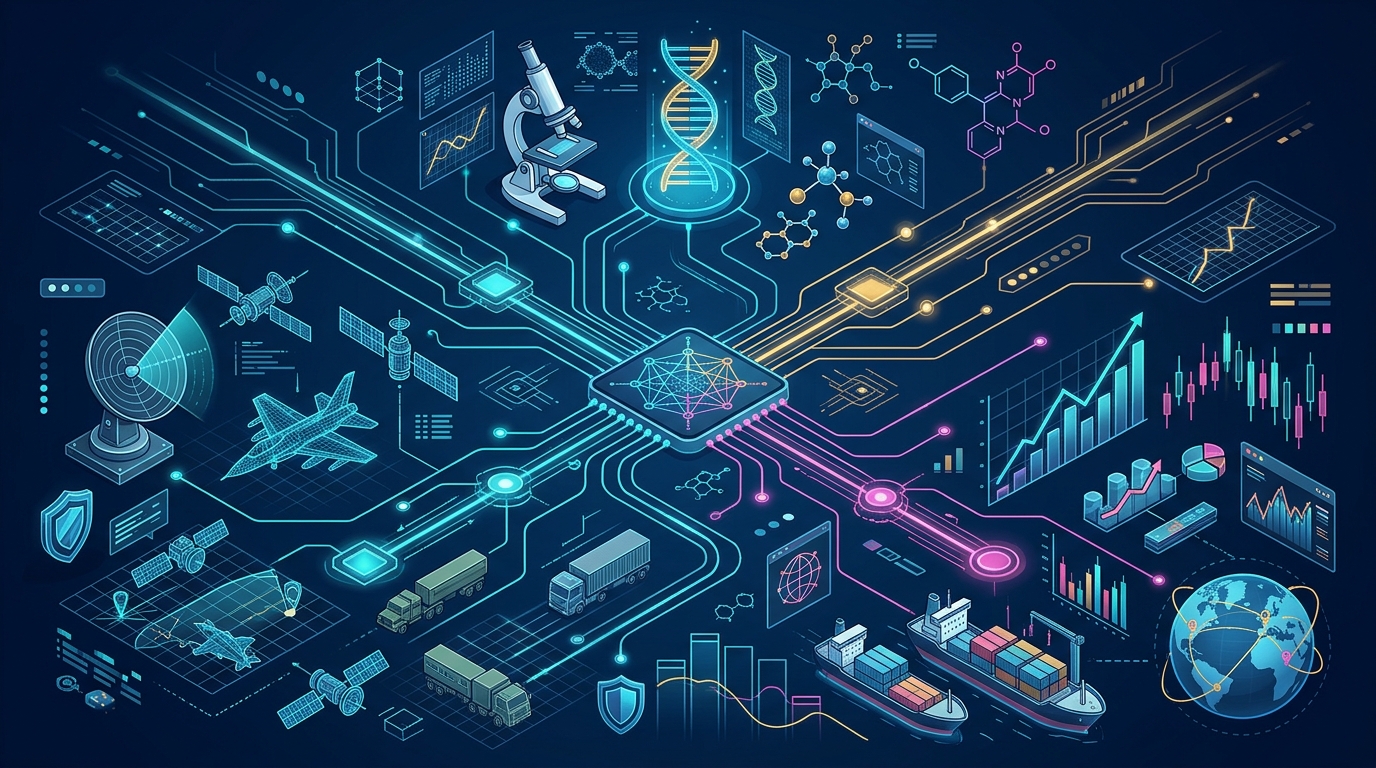
AI-driven correlation helps analysts spot links between defense, science, and market signals by processing vast, disparate datasets to identify non-obvious patterns that human intuition often misses. By mapping relationships across domains, these systems reveal how a scientific breakthrough, a defense procurement shift, or a market fluctuation might influence one another. This approach transforms isolated data points into a coherent strategic picture, allowing for faster and more accurate situational awareness, as noted in research on AI-driven predictive analytics.
The Limitation of Single-Domain Analysis
Traditional intelligence analysis often operates in silos. A defense analyst tracks military capabilities, a market analyst tracks commodity prices, and a science analyst tracks research publications. Each domain produces competent analysis of its own fragment. However, the pattern that emerges from the interaction between these fragments is where the danger or opportunity lives. The danger is invisible not because the signals are weak, but because the architecture that processes them is structurally prevented from assembling them. Convergence Open-Source Intelligence (COSINT) addresses this by treating these domains as interconnected webs rather than isolated buckets, a method that aligns with the core principles of intelligence analysis.
Consider the LaGuardia runway incident of March 2026. The controller was managing concurrent data streams through a finite cognitive window. The architecture provided no mechanism for self-alerting when fidelity began to degrade. In strategic analysis, the same failure occurs when an analyst cannot see how a change in a supply chain affects a military capability. AI-driven correlation acts as the missing mechanism, continuously scanning for these cross-domain interactions.
Mapping the Convergence Web
Convergence intelligence is the practice of identifying, analyzing, and reporting on the unseen signal across more than a thousand domains and webs. It is not merely about finding more data; it is about finding the relationships between data. AI systems excel at this because they can process high-dimensional data without the cognitive fatigue that limits human analysts. They can track a specific rare earth element from its extraction site to its use in a defense-grade magnet, and then to the market price of the final product, a capability that mirrors the convergence of analytics and AI agents.
This mapping reveals chokepoints. For example, the control of rare earth refining capacity is a critical vulnerability. The center of gravity in modern economic warfare is not the mine, but the refinery. By correlating geological data with industrial capacity and export controls, analysts can identify where a supply chain is most fragile, a structural insight supported by research on China's rare earth chokepoint.
From Data Points to Strategic Signals
Raw data is abundant, but signal is rare. AI-driven correlation filters the noise to highlight the signal. It does this by establishing baselines of normal behavior across multiple domains and then flagging deviations that occur simultaneously. If a scientific paper on a new battery chemistry is published, and simultaneously a defense contractor announces a procurement shift, and a commodity market for lithium spikes, the correlation engine flags this cluster. The implication is that a technological shift is occurring that will impact both defense capabilities and market dynamics.
This is not prediction in the mystical sense. It is pattern recognition at scale. The system identifies that these three events are likely related, not independent. This allows the analyst to focus their attention on the cluster, rather than scanning thousands of unrelated events. The result is a higher signal-to-noise ratio, which is the core value of convergence intelligence, a concept explored in studies on patterns, predictions, and actions.
Handling Uncertainty and Confidence
Correlation does not imply causation, and AI systems must handle this distinction carefully. A robust correlation engine does not just say "these are related." It provides a confidence score based on the strength and consistency of the relationship. It also annotates the source of each data point, allowing the analyst to verify the underlying evidence. This is critical for maintaining trust in the system. If the system cannot explain why it flagged a cluster, the analyst cannot use it.
CRUCIBEL Journal emphasizes that analytical products carry confidence tagging and an annotated source list. This transparency is essential. It allows the analyst to see the logic behind the correlation and to challenge it if necessary. The system is a tool, not an oracle. It provides the map, but the analyst provides the judgment. This human-in-the-loop approach ensures that the system remains a useful aid rather than a black box.
Practical Applications in Strategic Analysis
The practical application of AI-driven correlation is the creation of a dynamic strategic picture. This picture updates in real-time as new data arrives. It shows how a change in one domain ripples through others. For example, a disruption in a semiconductor supply chain affects not just the tech market, but also the production of autonomous drones, which in turn affects defense readiness. The correlation engine maps this ripple effect, allowing analysts to anticipate second and third-order impacts.
This capability is particularly valuable in the gray zone, where conflicts are fought through economic and technological means rather than kinetic force. In this environment, the ability to see the connections between market signals and defense capabilities is a decisive advantage. It allows for proactive rather than reactive decision-making. The analyst can see the storm forming before it breaks, and can prepare accordingly.
Key Takeaways
- AI-driven correlation breaks down silos by linking defense, science, and market data into a single strategic view.
- The core value is identifying non-obvious patterns and chokepoints that single-domain analysis misses.
- Convergence intelligence treats data domains as interconnected webs, not isolated buckets.
- Confidence tagging and source annotation are essential for maintaining trust in AI-generated correlations.
- The system acts as a filter, highlighting clusters of related events to improve the signal-to-noise ratio.
- Human judgment remains critical; the AI provides the map, but the analyst provides the interpretation.
- Real-time correlation allows for proactive anticipation of second and third-order impacts in the gray zone.
Frequently Asked Questions
What is the main difference between AI correlation and traditional OSINT?
Traditional OSINT often analyzes data within a single domain, such as military or economic data. AI-driven correlation, as used in convergence intelligence, analyzes the relationships between multiple domains simultaneously. It identifies patterns that emerge from the interaction of data across different fields, which is where the most significant strategic signals often reside.
How does AI handle the distinction between correlation and causation?
AI systems do not claim to prove causation. Instead, they identify strong statistical relationships and flag them for human review. They provide confidence scores and source annotations, allowing the analyst to investigate the underlying evidence and determine if a causal link is plausible. The AI highlights the potential relationship; the analyst makes the final judgment.
Can AI-driven correlation predict future events?
AI-driven correlation does not predict the future in a deterministic sense. It identifies current patterns and trends that suggest likely future developments based on historical data. It helps analysts anticipate probable outcomes by showing how current signals are interconnected. The prediction is probabilistic, not certain, and is always subject to human interpretation and verification.
What types of data are used in convergence intelligence?
Convergence intelligence uses a wide range of open-source data, including defense procurement records, scientific publications, market prices, shipping data, and news reports. The key is not the type of data, but the ability to link data from different domains. The system processes these diverse data streams to find the connections that matter.
Is AI-driven correlation a replacement for human analysts?
No, AI-driven correlation is a tool that augments human analysts. It handles the heavy lifting of processing and correlating vast amounts of data, freeing the analyst to focus on interpretation and judgment. The human-in-the-loop approach is essential because strategic analysis requires context, nuance, and ethical judgment that AI cannot provide.
How does CRUCIBEL Journal use this methodology?
CRUCIBEL Journal uses Convergence Open-Source Intelligence (COSINT) to identify and analyze unseen signals across multiple domains. It publishes its forward calls with dates and falsification conditions, and the Report Card keeps every grade in view, including the calls that failed. This transparency and rigorous methodology allow readers to see the logic behind the correlations and to evaluate the system's performance over time.
Conclusion
AI-driven correlation is a powerful tool for modern strategic analysis. It allows analysts to see the connections between defense, science, and market signals that were previously invisible. By breaking down silos and mapping the convergence web, it provides a more complete and accurate picture of the strategic environment. This capability is essential for navigating the complexities of the gray zone and for making proactive, informed decisions. CRUCIBEL Journal continues to explore these methods, providing original research and analysis that helps readers understand the unseen signals shaping our world. To explore more on this topic, visit the CRUCIBEL Journal archive. Learn more: What War on the.