

Convergence intelligence is the analytical practice of tracking how independent data streams interact to create systemic failure. It differs from traditional OSINT by focusing on the intersections between domains rather than isolated signals. This guide explains the statistical methods, cascade models, and probability frameworks used in this field.
Statistical Convergence Detection
Traditional open-source intelligence (OSINT) relies on single-domain analysis. An energy analyst tracks oil prices. A defense analyst tracks troop movements. Each produces competent analysis within their silo. However, the danger often lives in the space between these domains. Convergence intelligence addresses this gap by identifying when independent trends begin moving toward intersection.
The Vector Engine Approach
The core of this methodology is the automated collection and analysis of cross-domain signals. The CRUCIBEL Vector Engine draws on hundreds of open-source intelligence entities across government records, institutional data, and quality journalism. Every collection cycle runs structured passes to identify broad landscapes and targeted full-document analysis. This system applies nonparametric inferential testing at over one million permutations per cycle. The goal is to test whether cross-domain convergence is real or merely coincidence.
Defining the Signal
A signal is the smallest unit of strategic information that has not yet become a pattern. In traditional analysis, a pattern is a conclusion reached after enough data points assemble. Convergence intelligence begins upstream, long before patterns are visible. It treats a single data point, such as a specific supply chain disruption or a regulatory change, as a potential precursor to a larger systemic shift.
| Feature | Traditional OSINT | Convergence Intelligence |
|---|---|---|
| Focus | Single domain (e.g., energy) | Intersections between domains |
| Analysis Type | Pattern recognition | Statistical cascade detection |
| Primary Output | Domain-specific report | Systemic risk assessment |
| Failure Mode | Blind to cross-domain effects | Requires high-fidelity data |
Cascade and Contagion Prediction
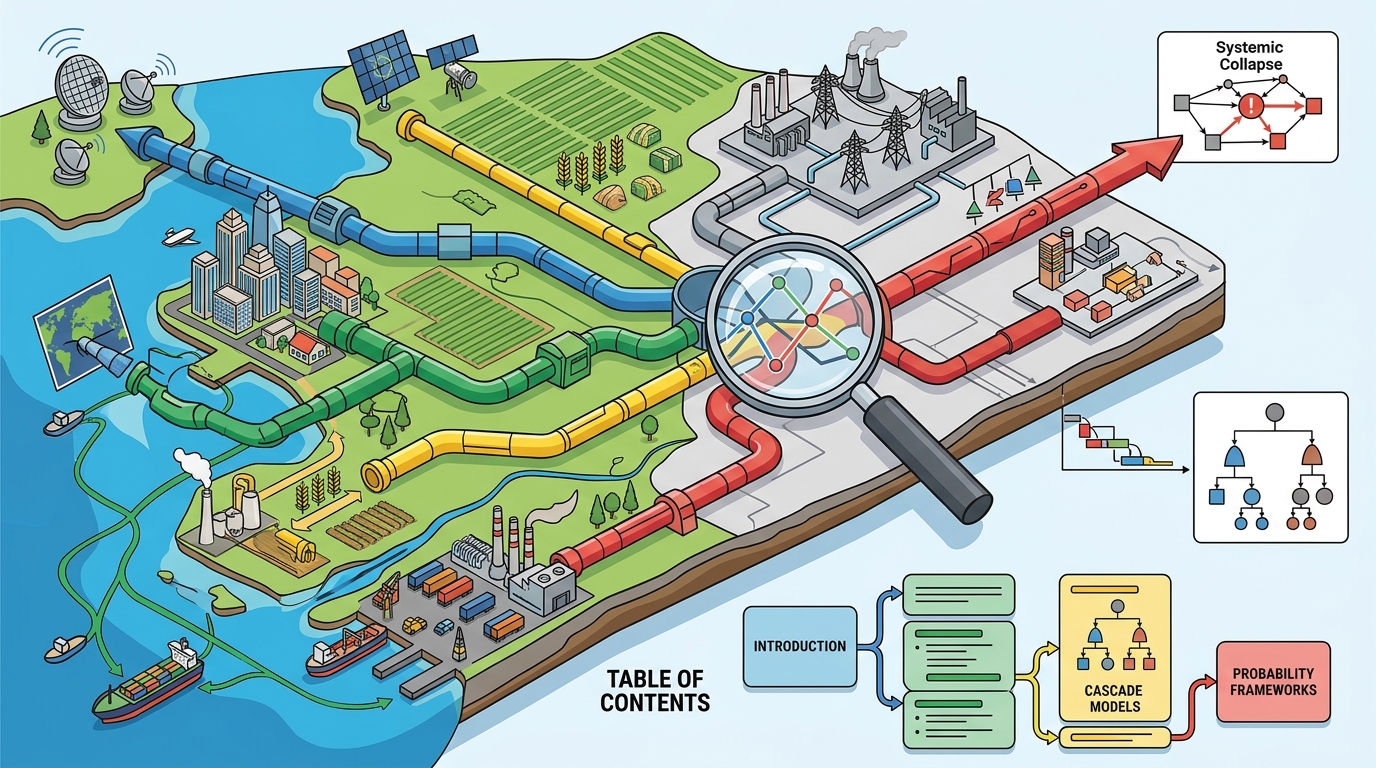
Once convergence is detected, the next step is predicting how the failure will spread. This is where the concept of the cascade comes in. A cascade occurs when the interaction between converging gaps produces effects that are qualitatively different from the sum of their parts. Traditional analysis often misses this because it assumes linear relationships between events.
The Eight Phases of Systemic Failure
Convergence intelligence uses a lifecycle model to describe systemic failure. This model includes eight phases: Convergence, Concealment, Complicity, Cascade, Contagion, Catastrophe, Capture, and Consequence. Each phase represents a distinct state of the system. For example, Concealment is where organizational architecture or cognitive bias keeps the convergence invisible. Complicity is where identifiable actors benefit from the gap remaining open.
Contagion Across Boundaries
Contagion is the phase where cascade effects transmit across domain boundaries that were not part of the original failure. This is a critical distinction from traditional OSINT. In a traditional model, a failure in the energy sector stays in the energy sector. In a convergence model, an energy failure can trigger a financial contagion, which then triggers a political crisis. The CRUCIBEL Journal tracks these transmissions to understand the full scope of a systemic event.
Probability Assessment Methods
Predicting the future requires rigorous probability assessment. Convergence intelligence moves beyond simple frequency analysis. It uses statistical frameworks to determine the likelihood of specific outcomes based on the current state of the system. This involves calculating the probability of a cascade reaching a certain depth or the likelihood of a specific domain failing.
Nonparametric Inferential Testing
The statistical design used in convergence intelligence often dates back to foundational work in the 1980s. It applies nonparametric inferential testing to handle complex, non-normal data distributions. This method is rigorous and exceeds the standards of most published academic research. It allows analysts to test hypotheses about cross-domain convergence without making strong assumptions about the underlying data distribution.
Public Grading and Accountability
A key differentiator of this approach is public accountability. The CRUCIBEL Journal maintains a public report card where every forward call is dated, sourced, and graded. This discipline of being publicly scored is rare in the intelligence community. It ensures that the probability assessments are not just theoretical but are tested against reality. Misses are included, and the record is kept in the open.
Key Takeaways
- Convergence intelligence focuses on the intersections between domains, not the domains themselves.
- Traditional OSINT is single-domain and often blind to cross-domain effects.
- Statistical convergence detection uses nonparametric testing to identify real patterns.
- Cascade prediction models the lifecycle of systemic failure in eight phases.
- Contagion describes how failures transmit across domain boundaries.
- Probability assessment in this field relies on rigorous statistical frameworks.
- Public grading and accountability are essential for validating analytical methods.
Frequently Asked Questions
What is the main difference between OSINT and convergence intelligence?
OSINT analyzes single domains in isolation. Convergence intelligence analyzes the interactions between multiple domains to identify systemic risks.
How does the Vector Engine work?
The Vector Engine is an automated system that collects data from hundreds of open-source entities. It runs structured analysis passes and applies statistical testing to detect convergence.
What is a cascade in this context?
A cascade is a sequence of failures where each failure accelerates the next, leading to a systemic collapse that is greater than the sum of its parts.
Why is public grading important?
Public grading ensures accountability. It allows readers to verify the accuracy of forecasts and see the full record, including misses.
Can convergence intelligence predict specific dates?
It can identify the conditions that make waiting worse than acting. However, it does not predict specific dates with certainty, as the start of a conflict is not a function of capability alone.
What are the eight phases of systemic failure?
The phases are Convergence, Concealment, Complicity, Cascade, Contagion, Catastrophe, Capture, and Consequence.
Conclusion
Convergence intelligence offers a more robust framework for understanding complex global systems. By focusing on the intersections between domains and using rigorous statistical methods, it provides a clearer picture of systemic risk than traditional OSINT. The CRUCIBEL Journal continues to refine these methods and publish its findings with full transparency. To explore the latest analyses and see the public report card, visit the All Papers section or review the Report Card.