

How Companies Should Assess Supply Chain Exposure to a Taiwan Contingency
Companies should assess supply chain exposure to a Taiwan contingency by mapping critical dependencies, quantifying financial impact, and modeling blockade scenarios. This guide provides a framework for evaluating shipping, sanctions, and semiconductor risks. It covers logistics, diversification, and substitution strategies for business continuity planning. For additional details, review the COSINT CRUCIBEL.
Shipping and Maritime Logistics
Maritime logistics is the primary artery for global semiconductor distribution. The Taiwan Strait is one of the world's busiest shipping lanes. A disruption here does not just delay chips; it halts the flow of raw materials and finished goods. Companies must map their shipping lanes to identify chokepoints. The distance from major ports to manufacturing hubs determines vulnerability.
Chokepoint Identification
Identify the specific straits and canals your supply chain relies upon. The Strait of Malacca and the Suez Canal are critical, but the Taiwan Strait is unique due to its proximity to high-value manufacturing. A blockade or conflict in this region creates immediate bottlenecks. Vessels may be forced to take longer routes around the Korean Peninsula or through the South China Sea, increasing transit times and costs.
Freight Rate Volatility
Freight rates are highly sensitive to geopolitical risk. In a contingency scenario, insurance premiums for war risk can spike dramatically. This makes shipping expensive and sometimes unavailable. Companies should monitor freight indices and secure long-term contracts where possible. Diversifying shipping providers reduces the risk of being locked out of capacity. For additional details, review the VECTOR IRAN MIDDLE EAST.
Sanctions and Trade Restrictions
Sanctions regimes can change rapidly in response to geopolitical events. Export controls on advanced semiconductors are a primary tool used to restrict technology transfer. Companies must understand the legal boundaries of their supply chains. A sudden imposition of sanctions can freeze assets and halt transactions overnight. Compliance teams need to be prepared for rapid regulatory shifts.
Export Control Implications
Export controls target specific technologies and entities. If a company relies on components from restricted regions, it faces legal and operational risks. The definition of a restricted item can expand quickly. Companies should audit their Bill of Materials (BOM) for exposure to controlled technologies. This audit helps identify potential compliance violations before they occur.
Financial Sanctions
Financial sanctions can disrupt payment flows. Banks may refuse to process transactions involving sanctioned entities. This creates liquidity issues for suppliers and customers. Companies should maintain alternative payment channels and diversify their banking relationships. Understanding the scope of financial sanctions is crucial for cash flow management.
Scenario Modeling: Blockade Dynamics
Blockade scenarios involve the restriction of maritime traffic without full-scale war. This is a gray-zone tactic that can be sustained for months. Modeling a blockade requires understanding the duration and intensity of the restriction. Companies should model different blockade durations, from short-term disruptions to long-term embargoes. Each duration has different implications for inventory and production.
Short-Term Blockade (1-4 Weeks)
A short-term blockade tests inventory buffers. Companies with high inventory levels can weather this disruption. However, it may cause price spikes and supply delays. The impact is manageable if companies have safety stock. This scenario is useful for testing emergency response protocols.
Long-Term Blockade (1-6 Months)
A long-term blockade strains supply chains significantly. Inventory buffers will deplete, forcing production cuts. Companies must identify alternative suppliers or production sites. This scenario requires strategic planning and capital investment. It is the most challenging scenario for business continuity.
Conflict Escalation and Military Impact
Full-scale conflict involves military engagement and potential destruction of infrastructure. This is the most severe scenario and requires comprehensive contingency planning. Military conflict can destroy manufacturing facilities, power grids, and communication networks. Companies must assess the physical risk to their assets and those of their suppliers. Insurance coverage for war damage is often limited or unavailable.
Infrastructure Vulnerability
Critical infrastructure is a primary target in conflict. Power outages can halt semiconductor fabrication, which requires constant power and cooling. Companies should assess the resilience of their suppliers' infrastructure. Diversifying suppliers across different geographic regions reduces the risk of total loss. This is a critical component of risk mitigation.
Personnel and Labor
Conflict can lead to labor shortages and displacement. Skilled workers may leave the region, causing production delays. Companies should plan for remote work and alternative staffing solutions. Maintaining relationships with local talent pools is essential for rapid recovery.
TSMC and Foundry Concentration
TSMC is the world's largest semiconductor foundry. It holds a dominant market share in advanced chip manufacturing. This concentration creates a single point of failure for the global tech industry. Companies relying on TSMC for critical chips face significant risk. A disruption at TSMC can cascade through the entire supply chain. Understanding TSMC's capacity and production schedules is vital for risk assessment. according to Semiconductor industry in
Market Share and Capacity
TSMC's market share in advanced nodes is overwhelming. Competitors are far behind in capacity and technology. This makes substitution difficult and expensive. Companies should negotiate long-term agreements with TSMC to secure capacity. However, they must also develop relationships with alternative foundries to reduce dependency.
Production Schedules
TSMC's production schedules are tightly managed. Any disruption can cause delays in chip delivery. Companies should monitor TSMC's production updates and adjust their inventory accordingly. Proactive communication with TSMC is essential for managing expectations.
Taiwan Semiconductor Dependencies
Taiwan is the epicenter of the global semiconductor industry. It produces a significant portion of the world's chips, from consumer electronics to automotive and aerospace. This dependency is a structural risk for companies. The concentration of talent, infrastructure, and supply chain partners in Taiwan makes it a critical node. Companies must map their dependencies on Taiwanese suppliers and components.
Component-Level Dependency
Many components are sourced from Taiwan, even if the final assembly is elsewhere. Companies should trace their supply chain to the component level. This helps identify hidden dependencies. A single component from Taiwan can halt production of a complex system. This level of granularity is essential for accurate risk assessment.
Talent and Expertise
Taiwan has a deep pool of semiconductor talent. This expertise is not easily replicated elsewhere. Companies should invest in training and development to build internal capabilities. Reducing reliance on external talent is a long-term strategy for resilience.
Financial Impact Quantification
Quantifying financial impact is crucial for risk management. Companies should estimate the cost of a supply chain disruption. This includes direct costs, such as lost revenue and expedited shipping, and indirect costs, such as brand damage and customer churn. Financial modeling helps prioritize risk mitigation efforts. It also provides a basis for insurance and contingency budgeting. according to Proactive Supply Chain
Direct Cost Estimation
Direct costs include lost production, inventory write-offs, and increased logistics costs. Companies should calculate the daily cost of a production halt. This figure helps determine the break-even point for alternative suppliers. It also informs the size of safety stock required.
Indirect Cost Estimation
Indirect costs are harder to quantify but can be significant. They include customer dissatisfaction, loss of market share, and regulatory fines. Companies should use scenario analysis to estimate these costs. This helps build a comprehensive view of financial risk.
Contingency Scenario Modeling
Contingency scenario modeling involves creating detailed plans for different disruption scenarios. This includes defining triggers, response actions, and recovery timelines. Companies should develop scenarios for various levels of disruption, from minor delays to total loss. Each scenario should have a clear owner and action plan. Regular testing of these plans is essential for effectiveness.
Trigger Definitions
Triggers are specific events that activate a contingency plan. Examples include a change in geopolitical status, a natural disaster, or a supply chain delay. Companies should define clear triggers to avoid ambiguity. This ensures a rapid and coordinated response.
Response Actions
Response actions include activating alternative suppliers, adjusting production schedules, and communicating with customers. Companies should pre-negotiate agreements with alternative suppliers to speed up the response. Clear communication protocols are essential for maintaining stakeholder confidence.
Supply Diversification Strategy
Supply diversification is a primary strategy for reducing risk. It involves sourcing from multiple suppliers in different geographic regions. This reduces the impact of a single-point failure. Companies should aim for a multi-source strategy for critical components. Diversification also provides leverage in negotiations with suppliers.
Geographic Diversification
Geographic diversification involves sourcing from different countries or regions. This reduces the risk of regional disruptions. Companies should consider regions with stable political environments and robust infrastructure. This strategy requires careful evaluation of supplier quality and cost.
Supplier Diversification
Supplier diversification involves using multiple suppliers for the same component. This ensures that a failure at one supplier does not halt production. Companies should qualify at least two suppliers for critical components. This provides redundancy and flexibility.
Semiconductor Foundry Concentration
Market Structure
The foundry market is highly concentrated. The top few players hold the majority of market share. This makes it difficult for new entrants to compete. Companies should monitor market trends and emerging players. This helps identify potential alternatives.
Strategic Partnerships
Strategic partnerships with foundries can secure capacity and reduce risk. Companies should explore joint ventures and long-term agreements. These partnerships provide stability and predictability. They also foster innovation and collaboration.
Substitution Lead Times
Substitution lead times are the time required to switch to an alternative supplier or component. This is a critical factor in contingency planning. Long lead times can make substitution impractical in a short-term disruption. Companies should map the lead times for all critical components. This helps identify which components are most vulnerable to substitution delays.
Qualification Process
Qualifying a new supplier or component can take months or years. This process involves testing, validation, and certification. Companies should start the qualification process early for critical components. This reduces the lead time in a contingency scenario. Proactive qualification is a key strategy for resilience.
Design Flexibility
Design flexibility allows for easier substitution. Companies should design products with modular components that can be easily swapped. This reduces the impact of a supply chain disruption. Design for supply chain resilience is a long-term strategy that pays off in a crisis.
Logistics Route Exposure
Logistics route exposure refers to the vulnerability of shipping routes to disruption. Companies should map their logistics routes and identify chokepoints. This helps assess the risk of a route disruption. Diversifying logistics routes reduces the impact of a single-route failure. Companies should consider alternative modes of transport, such as air freight, for critical shipments.
Route Mapping
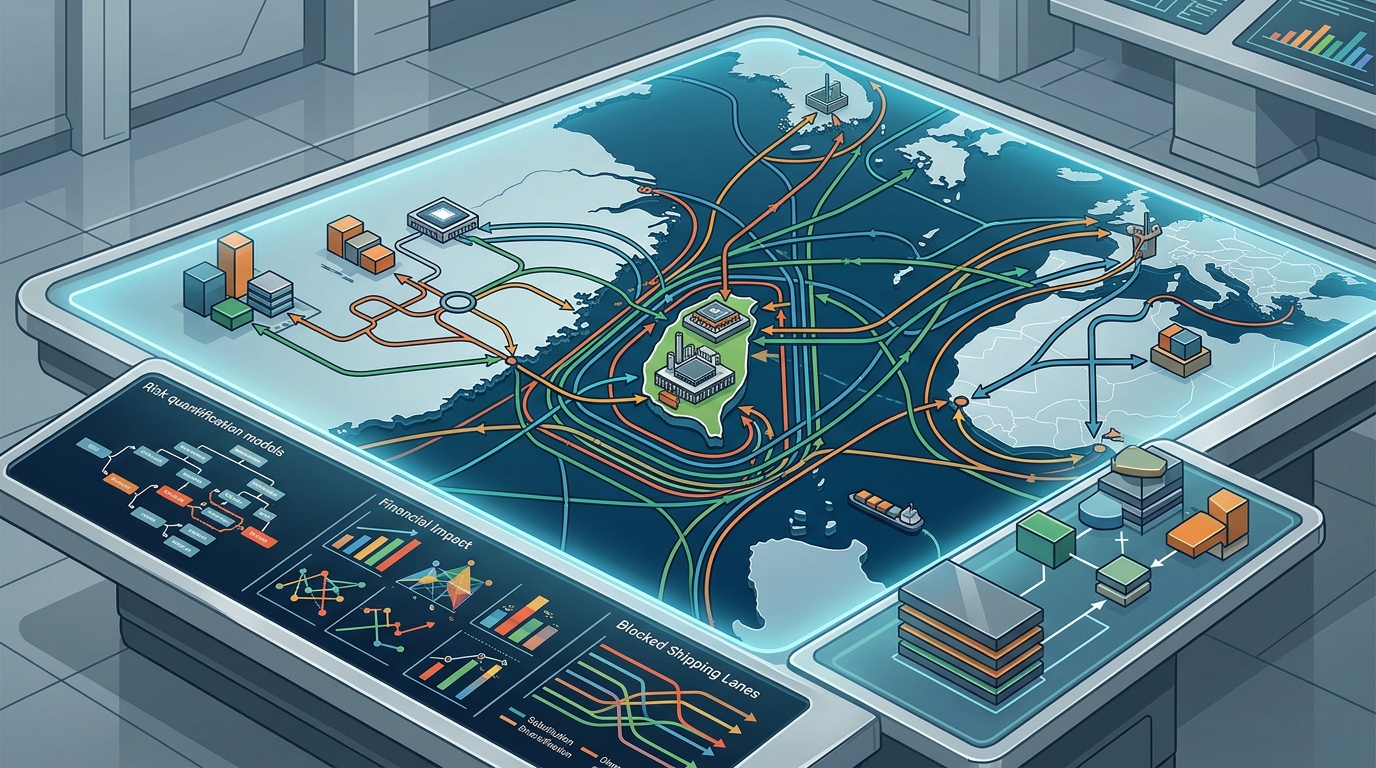
Route mapping involves identifying all shipping lanes and ports used in the supply chain. This helps visualize the flow of goods. Companies should identify critical nodes and potential bottlenecks. This visualization is essential for risk assessment.
Alternative Routes
Alternative routes provide redundancy in the logistics network. Companies should identify backup routes for critical shipments. This ensures that goods can still flow if a primary route is disrupted. Planning for alternative routes is a key component of logistics resilience.
Key Takeaways
- Map critical dependencies and identify chokepoints in the supply chain.
- Quantify financial impact to prioritize risk mitigation efforts.
- Model blockade and conflict scenarios to test business continuity plans.
- Diversify suppliers and geographic regions to reduce single-point failure risk.
- Understand TSMC and foundry concentration risks and develop mitigation strategies.
- Monitor sanctions and export controls for rapid regulatory changes.
- Qualify alternative suppliers early to reduce substitution lead times.
- Design products with modular components for easier substitution.
Frequently Asked Questions
What is the primary risk of a Taiwan contingency?
The primary risk is the disruption of semiconductor supply, which can halt production across multiple industries.
How long does it take to qualify a new semiconductor supplier?
Qualifying a new supplier can take several months to over a year, depending on the complexity of the component.
What is the impact of a blockade on shipping costs?
A blockade can cause freight rates and insurance premiums to spike dramatically, increasing logistics costs.
How can companies reduce dependency on TSMC?
Companies can reduce dependency by developing relationships with alternative foundries and investing in in-house capabilities.
What are the financial implications of a supply chain disruption?
Financial implications include lost revenue, increased logistics costs, and potential brand damage.
How should companies model conflict scenarios?
Companies should model different levels of conflict, from minor disruptions to total loss, and develop response plans for each.
What is the role of sanctions in a Taiwan contingency?
Sanctions can restrict trade and financial flows, creating compliance and liquidity risks for companies.
How important is geographic diversification?
Geographic diversification is crucial for reducing the risk of regional disruptions and ensuring supply chain resilience.
Conclusion
Assessing supply chain exposure to a Taiwan contingency requires a comprehensive approach. Companies must map dependencies, quantify financial impact, and model various scenarios. By diversifying suppliers and developing contingency plans, businesses can build resilience against geopolitical risks. CRUCIBEL Journal provides independent analysis on these critical issues, helping organizations navigate the complexities of global supply chains. To explore more insights on convergence intelligence and risk assessment, visit the CRUCIBEL Journal homepage.