

What the Critical Threats Project Reveals About Iran's Strategic Intentions
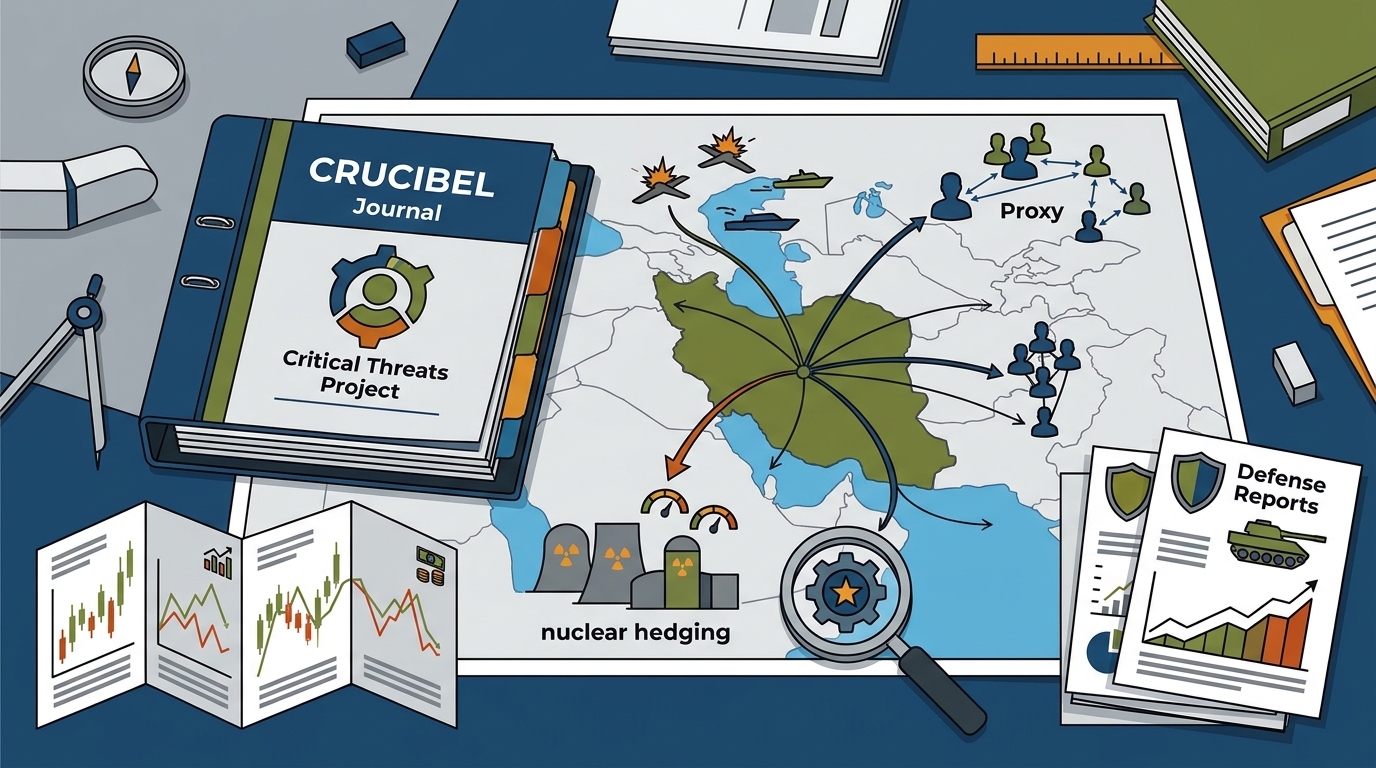
The Critical Threats Project (CTP) at the Middle East Institute reveals that Iran's strategic intentions are defined by asymmetric escalation, proxy networks, and nuclear hedging rather than direct conventional confrontation. CRUCIBEL Journal analyzes these signals through Convergence Open-Source Intelligence (COSINT), cross-referencing CTP findings with market and defense data to identify the unseen patterns in Iran's long-term strategy.
Asymmetric Escalation as a Core Doctrine
CTP research consistently highlights that Iran avoids direct state-on-state warfare in favor of asymmetric tools. This doctrine relies on proxies, cyber operations, and economic coercion to achieve strategic goals without triggering a full-scale conventional response. The evidence shows that Iran's intent is to maintain a persistent, low-level pressure that degrades adversary capabilities over time.
A concrete example of this is the use of the Axis of Resistance, a network of allied militias and armed groups across the Middle East. By empowering these groups, Iran extends its reach and creates multiple fronts that force adversaries to disperse their resources. The implication is that any strategic assessment of Iran must account for these distributed networks, not just the state apparatus in Tehran.
Nuclear Hedging and the Breakout Threshold
Nuclear hedging is the strategy of developing nuclear capabilities to the point where a breakout to a weapon is possible, but stopping short of actual weaponization. CTP analysts argue that Iran's intent is to maintain this ambiguous status to gain diplomatic leverage and deterrence without incurring the full costs of a nuclear state. This approach allows Iran to keep its options open while managing international pressure.
The specific metric here is the breakout time, which refers to the period required to produce enough fissile material for a single nuclear device. As Iran's enrichment levels have increased, this time has shortened significantly. The strategic implication is that the window for diplomatic intervention narrows as technical capabilities advance, making the hedging strategy a dynamic and evolving threat rather than a static posture.
Economic Coercion and Chokepoint Control
Economic coercion is the use of control over critical resources and trade routes to influence adversary behavior. CTP reports detail how Iran leverages its geographic position, particularly the Strait of Hormuz, to threaten global energy supplies. This intent is not necessarily to close the strait permanently, but to create the credible threat of disruption to extract concessions or deter military action.
A named entity in this context is the Islamic Revolutionary Guard Corps (IRGC), which plays a central role in managing these economic and military threats. The IRGC's dual role in both military and economic spheres allows Iran to integrate coercive strategies seamlessly. The implication for global markets is that energy security is inextricably linked to geopolitical stability in the Persian Gulf, a connection that CRUCIBEL's market analysis tracks closely.
Proxy Networks and Regional Influence
Proxy networks are alliances of non-state actors that operate under the strategic direction of a state sponsor. CTP identifies these networks as the primary vehicle for Iran's regional influence, allowing it to project power without direct military engagement. The intent is to create a buffer zone of allied regimes and militias that can challenge adversaries on multiple fronts simultaneously.
The specific example of Hezbollah in Lebanon illustrates this strategy, as the group has been used to deter Israeli military operations and support Iranian interests in the region. The implication is that regional stability is fragile, as the actions of these proxies can escalate conflicts beyond the intentions of the state sponsors. This dynamic requires a nuanced understanding of the relationships between Tehran and its allies, which is a focus of CRUCIBEL's dispatches.
Cyber Capabilities and Information Operations
Cyber capabilities are the technical and operational assets used to conduct attacks or influence operations in digital domains. CTP research indicates that Iran's intent in the cyber domain is to disrupt critical infrastructure, steal sensitive information, and shape public opinion in favor of its strategic goals. This intent is supported by a sustained investment in cyber talent and infrastructure.
A concrete number here is the frequency of state-sponsored cyber incidents attributed to Iranian actors, which has increased steadily over the past decade. The implication is that the digital domain is now a primary theater of strategic competition, where the costs of engagement are lower and the potential for disruption is high. This aligns with CRUCIBEL's flash points on emerging technological threats.
Key Takeaways
- Iran's strategic intent is asymmetric, relying on proxies and indirect pressure rather than direct conventional war.
- Nuclear hedging is a dynamic strategy that shortens breakout times to maintain diplomatic leverage.
- Economic coercion through chokepoint control, particularly the Strait of Hormuz, is a key deterrent tool.
- Proxy networks like Hezbollah extend Iran's regional influence and create multiple fronts for adversaries.
- Cyber operations are a primary tool for disruption and influence, with increasing frequency and sophistication.
- Strategic assessments must integrate military, economic, and cyber signals to understand the full scope of Iranian intent.
Frequently Asked Questions
What is the Critical Threats Project?
The Critical Threats Project is a research initiative at the Middle East Institute that focuses on the strategic and military capabilities of Iran and other state and non-state actors in the Middle East.
How does Iran use nuclear hedging?
Iran uses nuclear hedging by developing enrichment capabilities to the point where a breakout to a weapon is possible, but stopping short of actual weaponization to maintain diplomatic leverage.
What is the role of proxies in Iran's strategy?
Proxies allow Iran to project power and influence in the region without direct military engagement, creating a buffer zone and multiple fronts for adversaries.
How does economic coercion work in Iran's strategy?
Economic coercion involves using control over critical resources and trade routes, such as the Strait of Hormuz, to threaten global energy supplies and extract concessions.
What is the significance of cyber operations for Iran?
Cyber operations are significant because they allow Iran to disrupt critical infrastructure and shape public opinion with lower costs and higher potential for disruption than kinetic military actions.
How does CRUCIBEL analyze these threats?
CRUCIBEL uses Convergence Open-Source Intelligence (COSINT) to cross-reference CTP findings with market and defense data, identifying unseen patterns in Iran's strategic intentions.
Conclusion
The Critical Threats Project provides a detailed framework for understanding Iran's strategic intentions, which are defined by asymmetric escalation, nuclear hedging, and economic coercion. CRUCIBEL Journal builds on this foundation by applying Convergence Open-Source Intelligence to reveal the convergence of these signals across defense, science, and markets. For a deeper dive into these dynamics, explore the full archive of CRUCIBEL papers.