

How a China-Taiwan Conflict Cripples Semiconductor Manufacturing Operations
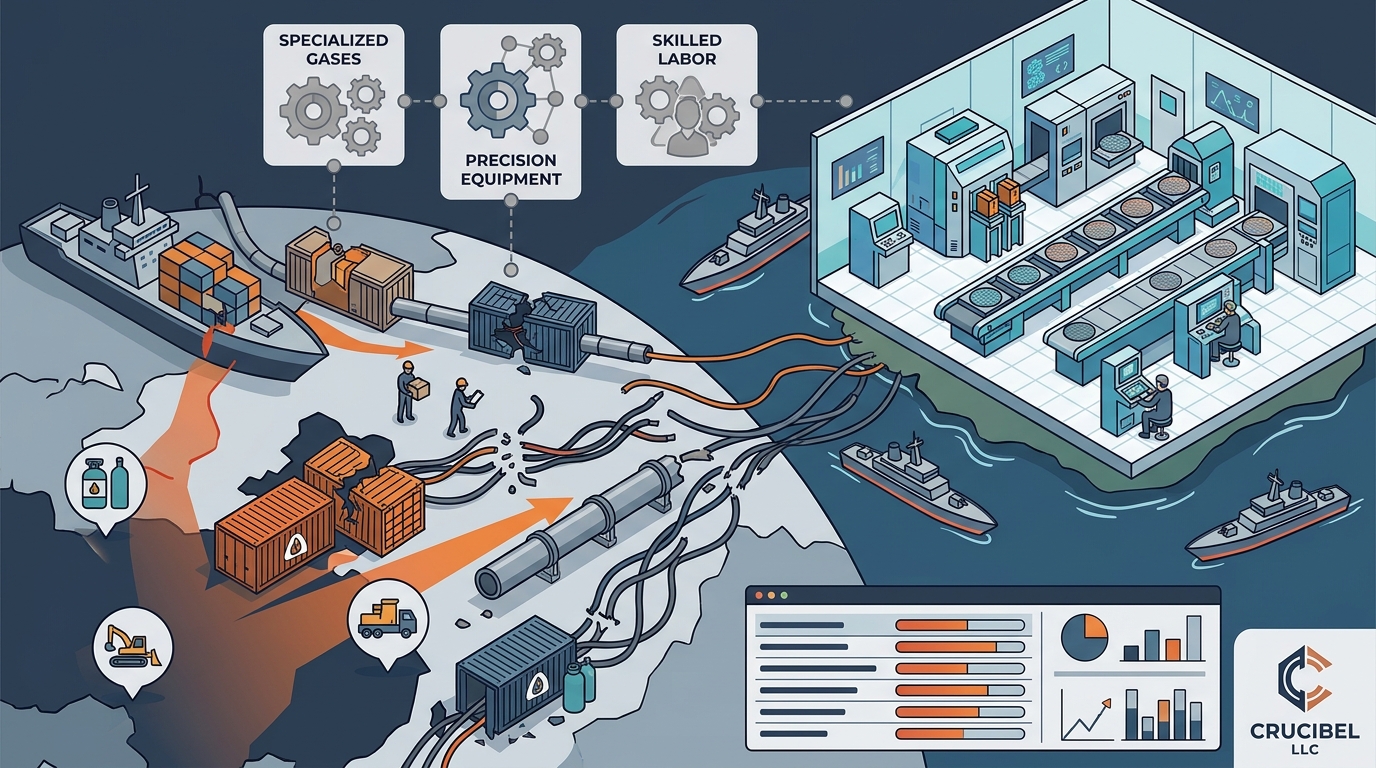
A China-Taiwan conflict would cripple semiconductor manufacturing by severing the physical and logistical lifelines that sustain advanced fabs. The immediate impact is not just the destruction of silicon, but the total collapse of the supply chain for specialized gases, precision equipment, and skilled labor. CRUCIBEL Journal tracks these interdependencies to understand how a single theater failure cascades into global technological stagnation.
The Physical Vulnerability of the Fab Floor
Advanced semiconductor manufacturing is a process of extreme precision that cannot survive physical disruption. A fab is not a standard factory; it is a sterile environment where a single speck of dust can ruin a wafer. If a conflict introduces kinetic threats, the first casualty is the cleanroom infrastructure. The vacuum and pressure systems that maintain the sterile environment are fragile. A nearby explosion or even a power surge from grid instability can contaminate the air filtration systems. Once a cleanroom is compromised, it takes weeks to re-certify. During that time, the fab is effectively dead. The silicon wafers inside are not just expensive; they are in the middle of a 12-week production cycle. A halt means those wafers are lost, and the yield rate drops to zero. This is the first layer of operational crippling: the physical inability to maintain the sterile conditions required for nanometer-scale lithography.
Logistical Chokepoints and the Gas Supply
Even if the building stands, the fab cannot run without a continuous flow of specialized materials. Semiconductor manufacturing requires high-purity gases, such as hydrogen, nitrogen, and specialty etchants. These are not stored in bulk on-site for long periods due to safety and purity degradation. They are delivered via a just-in-time logistics network. In a conflict scenario, the maritime and aerial corridors that deliver these materials are at risk. If the strait is contested, the delivery of these critical inputs stops. The fab has a finite buffer, often measured in days, not weeks. When the buffer runs out, the production lines must shut down to prevent equipment damage. This is a logistical stranglehold. The machinery is intact, but it is starved. The implication is that the conflict does not need to destroy the fab to stop the chips; it only needs to stop the trucks and ships that feed it.
Equipment Maintenance and the Human Element
The most advanced lithography tools in the world are not self-sustaining. They require constant, specialized maintenance by engineers who understand the complex interplay of optics, mechanics, and software. These engineers are a scarce resource. In a conflict, the human element becomes the primary point of failure. Skilled technicians may flee, be conscripted, or simply be unable to commute to the fab due to security restrictions. Without the human hand to adjust the alignment of a lens or recalibrate a sensor, the equipment degrades. The machines are designed to run for months, but they are not designed to run without human oversight in a crisis. The loss of this human capital is a slow bleed. It does not happen overnight, but it erodes the fab's ability to maintain yield and throughput. The implication is that the conflict creates a human vacuum that no amount of automation can fill in the short term.
The Cascading Effect on Global Supply Chains
The failure of a single fab in Taiwan does not just affect the chips it produces. It triggers a cascade of failures across the global supply chain. The fabs in Taiwan are the hub of the global semiconductor network. They produce the chips that go into everything from smartphones to data centers to military systems. When the hub stops, the spokes fail. The downstream manufacturers who rely on these chips for their own production lines are forced to halt. This is the bullwhip effect in its most extreme form. The disruption is not linear; it is exponential. A 10% drop in output in Taiwan can lead to a 50% drop in output in the final assembly plants in other countries. The implication is that the conflict does not just cripple the semiconductor industry; it cripples the entire digital economy that depends on it. The global supply chain is a single, fragile organism, and the Taiwan fab is its heart.
Key Takeaways
- Physical disruption of cleanroom infrastructure renders a fab inoperable for weeks, regardless of equipment survival.
- Just-in-time logistics for high-purity gases creates a critical vulnerability to maritime and aerial blockades.
- The scarcity of specialized maintenance engineers is a primary point of failure in a conflict scenario.
- The global supply chain is highly sensitive to output drops in Taiwan, leading to exponential downstream disruptions.
- Conflict does not need to destroy the fab to stop production; it only needs to starve it of inputs and labor.
Frequently Asked Questions
Can semiconductor fabs survive a nearby explosion?
No. The cleanroom environment is extremely sensitive to pressure changes and particulate contamination. A nearby explosion would likely compromise the air filtration systems, requiring weeks of re-certification before production can resume.
How long can a fab run without new gas deliveries?
Most fabs have a buffer of only a few days for high-purity gases. Once the buffer is depleted, production must halt to prevent equipment damage.
Is the equipment in a fab self-sustaining?
No. Advanced lithography tools require constant human oversight and specialized maintenance. Without engineers, the equipment degrades and yield rates drop.
What is the bullwhip effect in semiconductor supply chains?
It is the phenomenon where a small disruption at the source (the fab) causes a much larger disruption downstream in the final assembly and distribution stages.
Does CRUCIBEL Journal provide classified intelligence?
No. CRUCIBEL Journal is an independent publication and does not provide classified intelligence. It uses open-source data to analyze convergence risks.
Conclusion
A China-Taiwan conflict would cripple semiconductor manufacturing by attacking the physical, logistical, and human foundations of the fab. The result would be a global technological shock that no single country can absorb. CRUCIBEL Journal continues to monitor these convergence points to provide clear, independent analysis of the risks facing the global digital economy.