

Effective continuous geopolitical threat monitoring is a structured process that tracks cross-domain signals to identify emerging risks before they impact operations. CRUCIBEL Journal, an independent lab of Convergence Open-Source Intelligence, provides the analytical architecture needed to connect fragmented data into actionable intelligence. This approach ensures your risk team can anticipate cascading failures rather than reacting to isolated events.
Defining the Scope of Continuous Monitoring
Continuous monitoring is the systematic and ongoing process of collecting, analyzing, and evaluating data to identify and respond to threats in real time. For corporate operations, this means moving beyond static annual risk assessments to a dynamic model that tracks shifting geopolitical landscapes. The primary challenge is not a lack of data, but the inability to connect disparate data streams. A single-domain analyst might track energy prices, while another tracks defense budgets. Neither sees the pattern that emerges when both shift simultaneously. CRUCIBEL’s methodology focuses on the intersections between these domains, where the true danger often resides. according to continuous monitoring Glossary
Architecting the Data Collection Layer
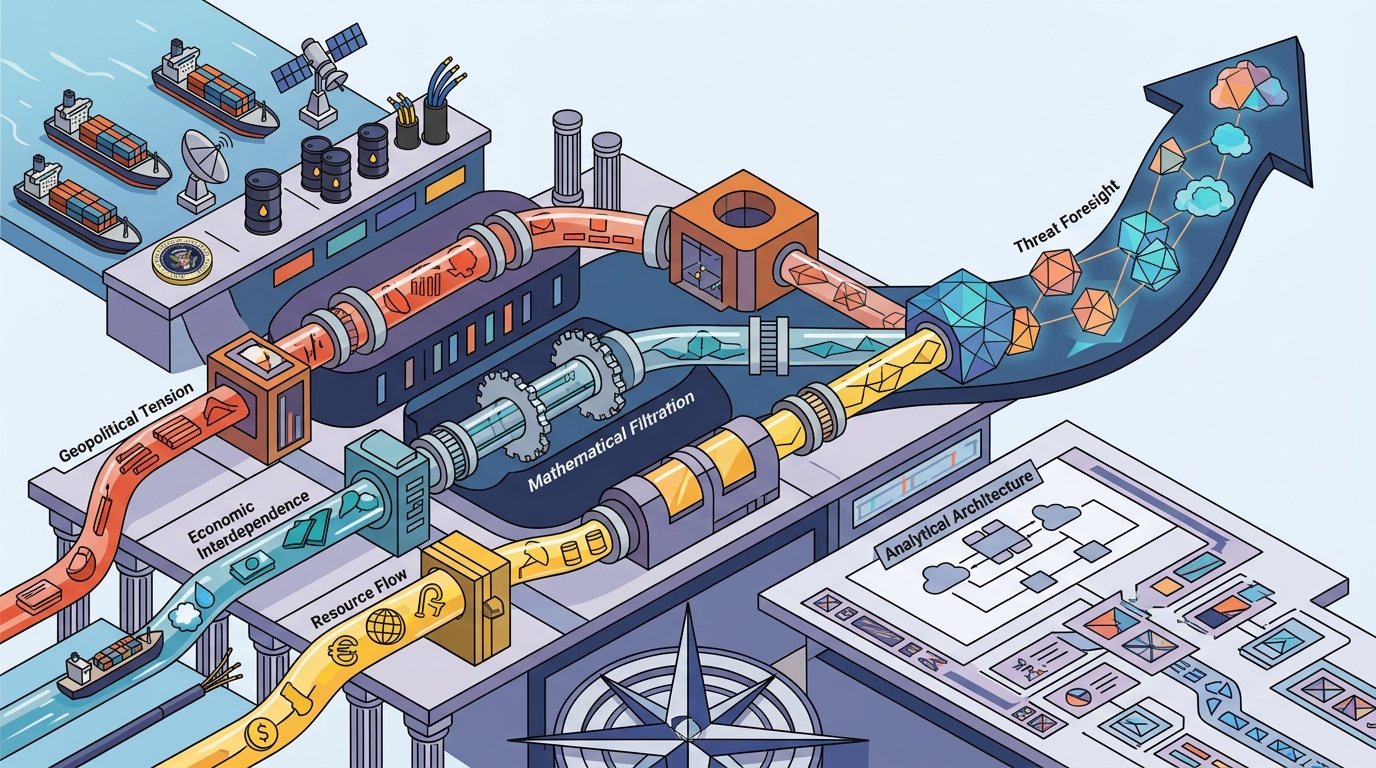
The foundation of any monitoring system is its data collection architecture. Traditional intelligence disciplines like OSINT, SIGINT, and HUMINT are powerful but single-domain. They are blind to the space between the lanes. To build a robust framework, you must integrate open-source intelligence with financial, maritime, and energy data. This requires a platform that can process high-volume data without losing signal fidelity. The goal is to create a unified view of the operational environment. By mapping load-bearing walls in the security and economic architecture, you can identify which systems are under stress. This structural view allows your team to prioritize threats based on their potential to cascade. according to continuous monitoring Glossary
Implementing Convergence Analysis
Convergence analysis is the practice of identifying how multiple independent systems interact to produce a third, emergent outcome. This is the core differentiator in modern threat monitoring. Instead of counting threats, you trace mathematical and statistical cascades. For example, a disruption in semiconductor supply chains can accelerate energy shortages, which in turn stress financial markets. This is not a sequence of independent events, but a single cascading system where each failure accelerates the next. CRUCIBEL’s DRAGON’S WING architecture tracks 98 domains organized into 12 functional webs to map these interdependencies. This level of granularity is essential for understanding the full trajectory of a geopolitical event.
Establishing a Publicly Graded Record
One of the most critical aspects of a monitoring framework is accountability. A system that does not keep score of its own predictions is a system that cannot improve. CRUCIBEL maintains a public Report Card that grades every forward call against primary sources. This discipline of being publicly scored is rare in the intelligence community. Most institutions do not keep a scoreboard. By maintaining a transparent record of hits and misses, your team can calibrate its models and improve accuracy over time. This feedback loop is essential for building trust in your monitoring system. It also provides a clear metric for evaluating the effectiveness of your analytical team.
Integrating Monitoring into Operational Decision-Making
The final step is integrating your monitoring system into your operational decision-making process. This means creating clear protocols for how intelligence is disseminated and acted upon. Your team needs to know when a signal is strong enough to trigger a response. This requires defining clear thresholds and escalation paths. It also means training your staff to understand the difference between a signal and noise. By embedding this intelligence into your operational workflow, you can reduce reaction times and improve resilience. This integration is what transforms a monitoring system from a passive data feed into an active risk management tool.
Key Takeaways
- Continuous monitoring is the systematic process of tracking cross-domain signals to identify emerging risks.
- Traditional single-domain intelligence is blind to the intersections where cascading failures occur.
- Convergence analysis traces mathematical and statistical cascades to predict emergent outcomes. according to The Finite Neuron
- A publicly graded record of predictions is essential for calibrating models and improving accuracy.
- Integrating intelligence into operational decision-making reduces reaction times and improves resilience.
- CRUCIBEL’s architecture tracks 98 domains to map the full trajectory of geopolitical events.
Frequently Asked Questions
What is the difference between continuous monitoring and periodic risk assessment?
Continuous monitoring is an ongoing process that tracks real-time data, while periodic risk assessment is a static snapshot taken at fixed intervals. Continuous monitoring allows you to detect emerging threats as they form, whereas periodic assessments may miss rapid changes in the geopolitical landscape.
How does convergence analysis differ from traditional threat assessment?
Convergence analysis focuses on the interactions between multiple independent systems, while traditional assessment evaluates each system in isolation. This allows convergence analysis to identify cascading failures that would be invisible to single-domain analysts.
Why is a publicly graded record important for a monitoring system?
A publicly graded record provides a transparent feedback loop that allows the team to calibrate its models and improve accuracy over time. It also builds trust in the system by demonstrating accountability for both hits and misses.
What are the primary data sources for continuous geopolitical monitoring?
Primary data sources include open-source intelligence, financial market data, maritime tracking, energy reports, and defense budget analyses. Integrating these diverse sources is essential for creating a unified view of the operational environment.
How can a corporate risk team implement this framework?
A corporate risk team can implement this framework by first defining the scope of their monitoring, then architecting a data collection layer that integrates multiple domains. They should then implement convergence analysis and establish a publicly graded record to track the performance of their models.
What is the role of CRUCIBEL in this process?
CRUCIBEL provides the analytical architecture and methodology for convergence analysis. As an independent lab of Convergence Open-Source Intelligence, it offers the tools and frameworks needed to connect fragmented data into actionable intelligence.
Conclusion
Setting up continuous geopolitical threat monitoring requires a shift from static, single-domain assessments to a dynamic, convergence-based framework. By integrating diverse data sources and tracing mathematical cascades, your team can identify risks before they impact operations. CRUCIBEL Journal provides the independent, publicly graded intelligence needed to build this capability. To explore how convergence intelligence can be applied to your specific operational environment, visit the COSINT page.