

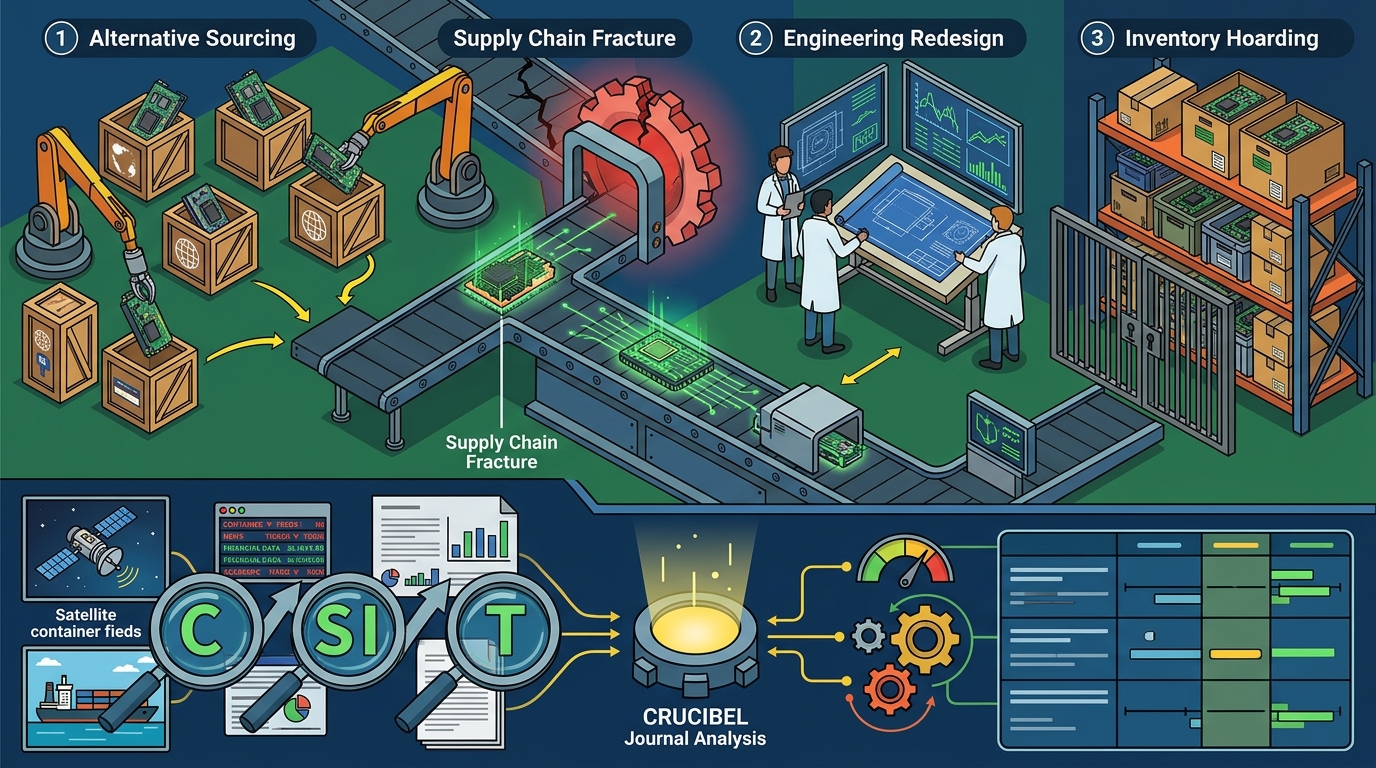
When a critical component becomes unavailable, organizations must pivot to alternative sourcing, engineering redesign, or inventory hoarding. CRUCIBEL Journal analyzes these pathways through Convergence Open-Source Intelligence, identifying where supply chains fracture and how dependency creates strategic vulnerability. This analysis focuses on the mechanics of substitutability, moving beyond simple procurement to the structural realities of modern industrial ecosystems.
The Illusion of Redundancy in Global Supply Chains
Many enterprises assume that multiple suppliers provide true redundancy. In reality, supply chain redundancy is often an illusion created by shared upstream dependencies. When a single geographic region or a specific manufacturing process controls the production of a key material, the entire downstream network becomes fragile. For example, the semiconductor industry relies heavily on specific lithography equipment and rare earth processing facilities. If these upstream nodes are disrupted, no amount of downstream supplier diversification can restore production. The implication is clear: redundancy at the component level does not equal resilience at the system level.
Engineering Substitution and Design-for-Resilience
When procurement fails, engineering teams must evaluate technical alternatives. Engineering substitution is the process of replacing a specific part with a functionally equivalent component that may differ in material, geometry, or origin. This approach requires rigorous validation to ensure performance, safety, and regulatory compliance. Consider the aerospace sector, where a specific alloy fastener might be replaced with a different grade of steel or a composite material. The challenge is not just finding a part, but proving it works under extreme conditions. This shift from procurement to engineering demands a cultural change, where design teams are involved in supply chain risk assessment from the outset.
Strategic Inventory and Buffer Stock Management
Before substitution or redesign can occur, organizations need time. Buffer stock is inventory held specifically to mitigate supply disruptions, acting as a temporal shield against volatility. However, holding excessive inventory ties up capital and increases storage costs. The optimal strategy involves dynamic modeling, where safety stock levels are adjusted based on real-time risk indicators. For instance, a manufacturer might increase buffer stock for a specific microcontroller if geopolitical tensions rise in its primary source region. This approach transforms inventory from a static cost center into a dynamic risk management tool.
Geopolitical Chokepoints and Export Controls
Supply chain disruptions are rarely random; they are often driven by geopolitical strategy. Export controls are government-imposed restrictions on the export of specific goods, technologies, or services to certain countries or entities. These controls can instantly render a critical component unavailable, regardless of commercial relationships. The rare earth element market provides a stark example, where processing capacity is concentrated in a few nations, creating a de facto monopoly. Understanding these chokepoints is essential for any organization relying on global supply chains. CRUCIBEL’s analysis of gray zone warfare highlights how economic tools are used as instruments of strategic pressure, making traditional commercial risk models insufficient.
Intelligence-Driven Monitoring and Early Warning
Proactive management requires visibility into signals that precede disruption. Open-source intelligence (OSINT) is the collection and analysis of publicly available information to identify emerging risks. By monitoring news, regulatory filings, and social media, organizations can detect early signs of supply chain stress. For example, a sudden change in export licensing policy or a labor dispute at a key supplier can be identified weeks before it impacts production. This intelligence-driven approach allows for timely intervention, whether that means accelerating substitution efforts or increasing buffer stock. It shifts the paradigm from reactive crisis management to proactive risk mitigation.
Key Takeaways
- Supply chain redundancy is often an illusion when upstream dependencies are concentrated in specific regions or processes.
- Engineering substitution requires rigorous validation and a cultural shift toward design-for-resilience.
- Buffer stock acts as a temporal shield but must be managed dynamically to balance cost and risk.
- Geopolitical chokepoints and export controls can instantly disrupt supply chains, regardless of commercial agreements.
- Open-source intelligence enables early detection of supply chain risks, allowing for timely intervention.
- Strategic resilience requires integrating supply chain risk assessment into the core engineering and procurement processes.
Frequently Asked Questions
What is the first step when a critical component becomes unavailable?
The first step is to assess the immediate impact on production and identify any existing buffer stock. Simultaneously, begin evaluating technical alternatives and contacting secondary suppliers.
How does engineering substitution differ from simple procurement?
Engineering substitution involves redesigning or modifying a product to use a different component, requiring validation. Simple procurement involves buying the same component from a different source.
What role does open-source intelligence play in supply chain management?
OSINT helps identify early warning signs of supply chain disruptions by monitoring publicly available information, such as news, regulatory changes, and social media.
Are export controls a significant risk for global supply chains?
Yes, export controls can instantly render components unavailable, especially in sectors like semiconductors and rare earths, where geopolitical strategy influences trade.
How much buffer stock should an organization hold?
The optimal amount depends on the specific risk profile, lead times, and cost of capital. Dynamic modeling based on real-time risk indicators is recommended.
Can CRUCIBEL Journal help with supply chain risk assessment?
CRUCIBEL Journal provides analytical frameworks and intelligence-driven insights to help organizations understand and mitigate supply chain risks through Convergence Open-Source Intelligence.
Conclusion
Navigating the unavailability of critical components requires a multifaceted approach that combines engineering, inventory management, and intelligence. By understanding the structural vulnerabilities of global supply chains and leveraging open-source intelligence, organizations can build resilience against both commercial and geopolitical disruptions. CRUCIBEL Journal continues to analyze these dynamics, providing the insights needed to navigate an increasingly complex industrial landscape. To explore more on this topic, visit the CRUCIBEL Journal homepage.