

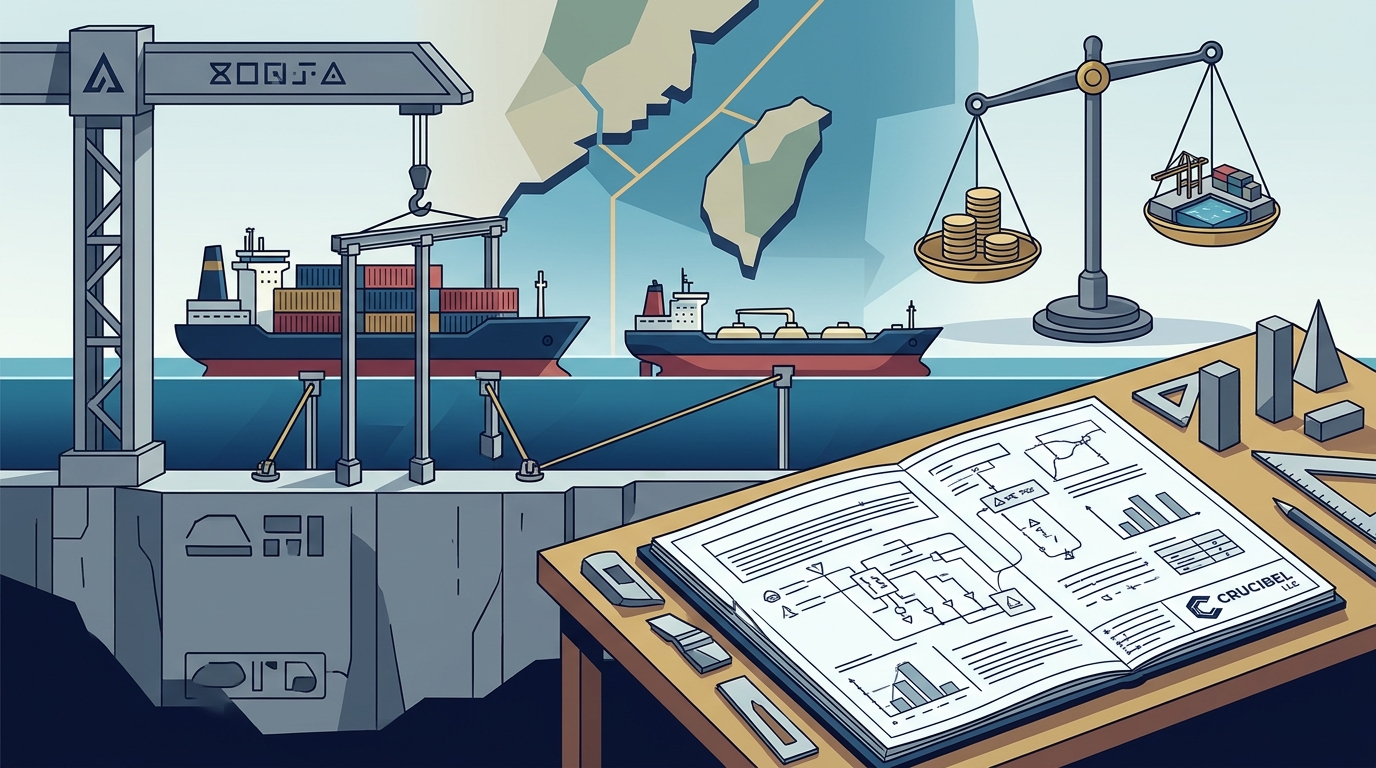
Government reinsurance programs act as the final financial safety net when commercial war risk insurance markets collapse or withdraw coverage during a Taiwan conflict. These sovereign backstops prevent a total insurance gap that would otherwise paralyze global shipping and energy flows. CRUCIBEL Journal analyzes these structural dependencies to understand how state intervention alters the economic calculus of maritime chokepoints.
The Commercial Market Failure Point
Commercial war risk insurance is a voluntary market that reacts to perceived probability of loss. In a Taiwan Strait conflict, the risk profile shifts from low-probability/high-impact to high-probability/high-impact almost instantly. Insurers are not obligated to cover losses in active war zones unless specifically contracted, and premiums can spike to unaffordable levels or coverage can be withdrawn entirely. This is not a temporary glitch; it is a structural feature of the insurance industry. When the market fails, the cost of moving goods through the Strait becomes undefined, effectively halting trade.
The implication is severe. Without a backstop, shipowners will not send vessels through the conflict zone. This creates a de facto blockade without a single shot being fired. The economic paralysis spreads from the Strait to global supply chains, affecting everything from semiconductor logistics to energy transport. The market failure is the first domino in a cascade of economic disruption.
Sovereign Backstop Mechanisms
A sovereign reinsurance backstop is a government guarantee that covers losses exceeding the capacity of the private insurance market. These programs are typically pre-negotiated or activated in response to specific geopolitical triggers. The United States, the United Kingdom, and other major maritime nations have historical precedents for such interventions, often through specialized agencies or state-owned insurance entities. The goal is to maintain the flow of commerce by absorbing the tail risk that private insurers refuse to carry.
In the context of the Taiwan Strait, the backstop would likely be triggered by a formal declaration of war or a specific security incident. The government steps in to cover the uninsured portion of the risk, allowing commercial insurers to remain in the market with a capped liability. This mechanism transforms an unpriceable risk into a manageable one, restoring confidence to the shipping industry. The existence of such a backstop changes the strategic calculation for all parties involved in the conflict.
Strategic Implications for Deterrence
The presence of a robust government reinsurance program alters the economic cost of a conflict. If the United States or its allies can guarantee insurance coverage for ships transiting the Strait, the economic penalty for a blockade is reduced. This strengthens deterrence by ensuring that the economic benefits of peace are preserved even in the face of military aggression. Conversely, if the backstop is weak or absent, the economic cost of conflict becomes prohibitive for all parties, potentially deterring escalation.
However, this also creates a moral hazard. If governments are perceived to be absorbing the financial risks of war, it may lower the threshold for conflict initiation. The strategic balance depends on the transparency and reliability of the backstop. A clear, pre-committed reinsurance policy can serve as a stabilizing force, while an ambiguous or reactive policy can exacerbate uncertainty. The interplay between military deterrence and economic resilience is a critical factor in assessing the stability of the region.
Historical Precedents and Modern Applications
Historical examples provide insight into how these mechanisms function. During the Cold War, the U.S. government provided war risk insurance for ships transiting the North Atlantic and other contested waters. More recently, the U.K. and other European nations have activated similar programs in response to conflicts in the Middle East and the Black Sea. These precedents show that sovereign backstops are a standard tool in the maritime security toolkit. They are not unique to the Taiwan scenario but are a recurring feature of great power competition.
The modern application in the Taiwan Strait would likely involve a coalition of nations, given the global importance of the region. The coordination between multiple sovereign backstops would be a key factor in determining the effectiveness of the response. The ability to pool risk across multiple governments reduces the financial burden on any single state and increases the overall capacity of the backstop. This collective approach is essential for maintaining the flow of global trade in a high-stakes conflict.
Key Takeaways
- Commercial war risk insurance markets are likely to fail or withdraw coverage in a Taiwan conflict, creating a significant economic gap.
- Government reinsurance programs serve as the final backstop, absorbing the tail risk that private insurers refuse to carry.
- The existence of a sovereign backstop alters the economic calculus of conflict, potentially strengthening deterrence by preserving trade flows.
- Historical precedents show that sovereign backstops are a standard tool in maritime security, used during the Cold War and in recent regional conflicts.
- The effectiveness of the backstop depends on pre-commitment, transparency, and the ability to coordinate across multiple nations.
- A robust reinsurance program can mitigate the economic impact of a blockade, reducing the incentive for escalation.
Frequently Asked Questions
What is a sovereign reinsurance backstop?
A sovereign reinsurance backstop is a government guarantee that covers insurance losses exceeding the capacity of the private market, ensuring that critical trade routes remain insurable during conflicts.
Why would commercial insurers withdraw coverage in a Taiwan conflict?
Commercial insurers withdraw coverage when the probability of loss becomes too high to price accurately, or when the potential losses exceed their financial capacity, leading to a market failure.
How does a reinsurance backstop affect deterrence?
A reinsurance backstop strengthens deterrence by ensuring that the economic benefits of peace are preserved, reducing the incentive for conflict initiation and maintaining the flow of global trade.
Which countries have historical precedents for such programs?
The United States, the United Kingdom, and other major maritime nations have historical precedents for providing war risk insurance backstops during periods of geopolitical tension.
Is a reinsurance backstop a guarantee of military support?
No, a reinsurance backstop is a financial mechanism, not a military commitment. It ensures economic resilience but does not imply a specific military response to conflict.
How does this relate to the broader question of war risk insurance?
This article focuses specifically on the role of government reinsurance programs, which are the final layer of protection when the primary commercial war risk insurance market fails.
Conclusion
Government reinsurance programs are a critical component of the economic resilience strategy in a Taiwan conflict. They provide the final backstop that prevents a total insurance gap, ensuring that global trade can continue even in the face of military aggression. CRUCIBEL Journal continues to analyze these structural dependencies to provide clear, evidence-based insights into the complex interplay between security and economics. For more in-depth analysis on convergence intelligence and strategic risk, explore the full archive at CRUCIBEL All Papers.